Street Fight: The 2014 EU Street Nomenclature Directive

2014 EU Street Nomenclature Directive

The 2014 EU Street Nomenclature Directive was a controversial piece of EU legislation intended to regulate and systematise the naming of streets in European Union member states. It’s primary function was to ensure that all EU streets were given unique names, with duplicate names altered, in order to clean up a system which the EU’s Committee for Transport, Tourism and Pedantry described as “repetitive, incomprehensible and needlessly convoluted” in a 438 page proposal submitted in 1994.

Though the bill was unpopular with the general European public, it was finally ratified in June 2014 amid controversy over aggressive negotiations by Belgian MEP Frédèric Delvaux to secure its passing. It was later revealed that Delvaux was in fact a majority shareholder in a European Law Consultancy firm which would subsequently make over €1.2 billion in providing legal advice to affected parties, during a litigation process which spanned more than 40 …

Humphrey Woodspring: Space Pioneer

A flyer for Woodspring's 1910 demonstration

Humphrey Woodspring was a British space-travel pioneer, who conducted the first rocket experiments of the Edwardian era. Woodspring was raised in Barnsley, and apprenticed as a carpenter in his father’s furniture manufacturer’s company, finally taking it over in 1903 at the age of thirty-one. That same year, Woodspring paid an enlightening visit to the cinema tent at the county fair which included a screening of the early French science-fiction film Un voyage en fusée pour visiter les dames grandes bosomed sur la surface de la lune (A trip by rocket ship to visit the well endowed ladies on the surface of the moon). Soon after he placed an advertisement in the Barnsley Echo which stated that Woodspring and Sons would henceforth dedicate itself to pursuing excellence in the twin fields of space exploration and home furnishings.

Seven years later, Woodspring was satisfied that he had finally constructed a rocket ship …

The Birth of the Centimetre

Carelli

One of the most well-known and much-loved units of length in the metric system, the centimetre was first proposed simultaneously in 1710 by Italian mathematican Luciano Carelli and Norwegian physicist Bernhard Boger. A bitter authorship debate ensued, with the central issue being the question of which physical phenomenon should be used as the basis of measurement. Carelli was adamant that a centimetre should be defined as “the width of the smallest finger on my leftmost hand, at the point directly between the finger nail and the upper knuckle”, but Boger dismissed this idea as absurd, arguing that the width of Carelli’s fingers was liable to change if he were to put on excessive weight, or to die and slowly decay. He instead proposed that a much more reliable definition would be the size of the gap between his writing desk and the wall of his study, pointing out that …

The Odassa 12 Experiment

The Odassa 12 experiment was an unorthodox scientific experiment carried out in the year 25670-12 by an extra-dimensional super-being and laboratory technician named Bl*wthr’k 25j. Bl*wthr’k was interested in exploring the properties of a pocket of space-time he had discovered under a discarded packet of radium in the laboratory car park, which he dubbed ‘the uuniv`rse’. Utilising ultra-microscopic equipment, he was able to precisely map out the complex arrangement of particles that constituted the uuniv`rse, and successfully identified an ultra-molecule of clay-like material that he believed would be fruitful for experimentation. On the night of Blensbury the unth, Bl*wthr’k conducted the following experiment, described in his journal:

Day 20-two. I have been observing the uuniv`rse for some time now, and have determined that it follows a regular cycle of steady expansion, followed by a sudden contraction to near-invisible level and then a violent explosion approximately every 16 hours. During …

Drummond Archives: The Inter-Dimensional Hotel

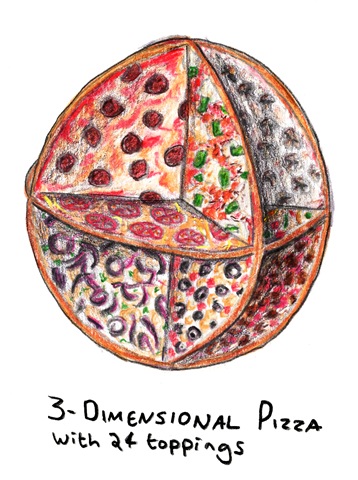
3D Pizza

In early 1939, Sir Henry Drummond – explorer, entrepreneur and creator of the Dancing Henry Almanac – emerged from his library after conducting a seven year study of the planet Earth and announced to the world that four things were essential to our continuing success as a race: higher oceans to promote water sports; better national youth programs, along the lines of those flourishing in Germany; slinkies; and an inter-dimensional hotel. Though few would dispute the wisdom of the first three propositions, the latter caused no small debate when Sir Henry first announced his findings during a lecture at the Tewkesbury Institute of Global Policy and Town Hall.

He recommended that a global committee of all (civilised) commonwealth nations be appointed in order to create a hotel suitable for inter-dimensional travellers. Located at a key juncture in the space-time slipstream it would allow guests to seamlessly exit their own …

Digest #000,009

The Cougar

After almost a month of bunking off in the snow, the Dancing Henry editorial team reluctantly trudged indoors this week to hang up their sledges and prepare another fabulous digest of entries from the world-famous Dancing Henry Almanac. They were greeted by a veritable mountain of letters and postcards, and promptly got their sledges back out to continue the party indoors. Though this still-snowballing pile of correspondence is currently blocking the entrance to the Dancing Henry archives, we have managed to throw together a few bits and pieces e-mailed to us by our global team this week, and present them to you well in advance of the next Almanac edition. This is, therefore, an internet exclusive and will not be found in any encyclopaedias or so-called “news” papers. We hope you enjoy this digest, and please rest assured that any fan-mail received this week will be properly processed, and will …

The Dancing Henry Guide to… Horror Films

Friedrich

For all of you who have ever wondered how the horror genre came to be one of the most enduringly popular in film history, how it forged and then constantly reinvented its own mythology, how it adapted itself to political and economic pressures, and why it is that the scantily-dressed heroine always insists on investigating the ominous noises in the basement, then we bring you this: the Dancing Henry Guide to Horror Films, and the answer to all your questions. Except that last one. No one knows that.

The roots of the horror genre are in the creepy silent classics made by a group of German film-makers in the early 1920s which were deeply influenced by expressionist art. To better portray the deranged worlds of their stories, geometric shadows would be painted directly on to backgrounds, and sets would be constructed with peculiar angles and sharp corners jutting …

Digest #000,008

Many concerned readers have emailed the Dancing Henry editorial offices recently, afraid that we might be adversely affected by the recession. Unfortunately, it is true that the Dancing Henry Corporation has had to make cuts. Our publishing department has now ceased printing once lucrative lines such as the A-Z of Numbers textbook, the Braille Guide to Silent Film and the Best of Ceefax Annual. Our merchandising department has now stopped manufacturing our range of Sir Henry Drummond action figures, our Months of the Year socks, and our famous spearmint bananas. And throughout the company we have made other minor cutbacks, including our library of betamax cassettes, our female employees and our electronic pistachio-sheller. Despite this, we still remain absolutely dedicated to bringing you this bi-occasional digest bang on time.

Nintendo Playa Super-high-definition video console released in 2017 featuring unique interactive controllers. One of the console’s most innovative games was …

Digest #000,007

Full Primary Colours Chart with Vibe included. (Content now removed due to legal request.)

The Dancing Henry editorial office has received a lot of correspondence this week asking for our thoughts on illusionist Derren Brown’s impressive ability to predict the national lottery – suggesting that this stunt warrants an entry in the almanac. Long time readers will know better however, as many of them will have received the free supplement with volume 57 of the twelfth edition of the almanac that contains unfailingly correct predictions for every lottery up until 2015 (the numbers generated with a formula created by Dancing Henry founder Sir Henry Drummond himself: asking a politician, or a feminist, or some other “damn fool” what they thought the numbers would be, and then picking the exact opposite). Unfortunately for many of you, this supplement is now out of print, as the Dancing Henry Organisation was simply unable to come up with a way of generating the extra revenue to keep it …

Digest #000,006

Example of a counterfeit trophy

If you’d like a second chance to see “The Dancing Henry Story”, a twenty-four-part TV mini-series chronicling the life of Dancing Henry founder Sir Henry Drummond’s struggle to create the Dancing Henry Almanac – despite resistance from censorship organisations, rival publishers, the church, heavy winds and gravity – then we would welcome funding for the £2.5 million production, giving you your first chance to see it as well.

Best Dad in the World Competition Global competition started by Dancing Henry founder Sir Henry Drummond in 1946, in an attempt to redress the worrying post-war situation of women being seen as almost equal to men. Ever year, Sir Drummond would scour newspapers and magazines from around the world to find cases of extraordinary heroism in the name of fatherhood, and the earliest winners of the competition would be men who had been willing to sacrifice everything for their children, and …